
CMA software for real estate agents turns hours of manual market research into a polished, data-backed listing presentation in minutes. Instead of pulling comps by hand, agents use these platforms to instantly compare recent sales, pricing trends, and property details, then generate a report homeowners can trust. For agents who also want to find sellers before a sign ever goes in the yard, pairing seller intelligence with CMA software for real estate agents means less guesswork and more signed listings.
This guide breaks down what these tools actually do, which features matter most, and how a platform like SellScore Pro folds CMA creation into a full listing workflow instead of treating it as a standalone task.
What Is CMA Software for Real Estate Agents?
CMA software for real estate agents is a digital tool that pulls recent comparable sales, active listings, and local market data to estimate a home's value and build a client-ready report. Rather than manually searching the MLS and formatting slides, agents get an automated comparative market analysis in a fraction of the time, often with branding, photos, and charts the homeowner can understand at a glance.
A traditional comparative market analysis is built by hand: an agent searches the MLS for similar homes, adjusts for square footage and condition, and formats a document in a spreadsheet or slide deck. That process can take an hour or more per listing appointment. Software compresses that work into a few clicks, which matters because speed often decides who gets the listing when a seller is talking to more than one agent.
However, not every CMA tool is built the same way. Some are standalone valuation calculators with no connection to leads or marketing. Others, like SellScore Pro, link the CMA directly to seller scoring, contact data, and nurture emails, so the report is just one step in a longer, automated relationship with the homeowner.
Why Manual Comparative Market Analysis Tools Slow Agents Down
Most agents learned to build a comparative market analysis the old-fashioned way, and that approach still works, but it is slow. Specifically, pulling comps, verifying square footage, and adjusting for upgrades can eat up an hour before a single slide is designed. As a result, many agents either rush the analysis or skip homeowners who seem like a longer shot.
In contrast, software-driven CMAs standardize the process. The agent still reviews and adjusts the comps, but the heavy lifting of pulling data and formatting a presentable report happens automatically. This frees up time for the parts of the job software cannot replace, such as explaining pricing strategy face to face.
According to the National Association of Realtors, homes sold without professional representation have historically sold for less than agent-assisted sales. That gap is part of the pitch agents make to sellers, and a fast, accurate CMA is the tool that proves it in dollars instead of just words.

Modern CMA software for real estate agents turns a manual comps search into a ready-to-present report.
How AI-Powered Listing Presentation Software Changes the Game
AI has changed what a listing presentation can look like. Instead of static slides, many platforms now generate a narrative summary of the market, highlight the strongest comps automatically, and flag pricing trends an agent might otherwise miss. Consequently, the agent spends less time formatting and more time coaching the seller on strategy.
For example, SellScore Pro's AI-powered CMA and listing presentation builder pulls property and market signals the same way its seller-scoring engine does, so the report feels consistent with everything else the homeowner has already seen, including a Personal Home Value Page or a Wealth Report shared earlier in the relationship.
This matters because homeowners increasingly check their own home value online before calling an agent. Furthermore, those automated estimates frequently disagree by tens of thousands of dollars on the same property, since an algorithm knows the property but not the home. A CMA that lets the homeowner add real detail, such as a finished basement or a new roof, closes that gap and builds trust faster than a generic number ever could.
Key Features to Look for in Comparative Market Analysis Software
Not every CMA tool deserves a spot in an agent's tech stack. Above all, the software should save real time, not just move the same manual work to a different screen. Here is what separates a genuinely useful tool from a glorified spreadsheet.
- Accurate, adjustable comps: the software should pull real comparable sales and let the agent override them when local knowledge says otherwise.
- Branded, mobile-friendly output: a report that looks professional on a phone or tablet during a kitchen-table listing appointment.
- Connection to seller data: ideally the same platform that flags a likely seller can generate the CMA used to approach them, rather than requiring a separate login.
- Engagement visibility: knowing whether a homeowner opened or revisited the report tells an agent exactly when to follow up.
Agents juggling a farming strategy alongside their CMA tool may also want to review this breakdown of real estate farming software that finds sellers first, since the two tools work best when they share the same data.
How SellScore Pro Brings CMA Software Into the Full Listing Workflow
A CMA is more useful when it is the final step in a workflow, not the only step. Therefore, SellScore Pro connects CMA creation to the same system that finds and nurtures the seller in the first place. Here is how that looks in practice.
- Find the sellers. The platform scores homes nationwide as Hot, Warm, or Cold based on seller signals, so agents know exactly where to prospect first instead of guessing.
- Get the contact. Contact Find adds verified names, phone numbers, and emails to the scored property, turning a prioritized address into someone an agent can actually call.
- Attract sellers. A Personal Home Value Page invites the homeowner to share upgrades and photos, giving the agent real seller intelligence before the first conversation even happens.
- Build the CMA. The AI-powered CMA pulls that same property data and the homeowner's self-reported upgrades into a client-ready report in minutes.
- Nurture and track. If the homeowner is not ready yet, 48 weekly emails keep the relationship moving for nearly a year, while engagement tracking shows exactly when interest picks up.
Agents who still rely on cold calling to follow up with scored leads often pair this workflow with a dialer; this comparison of an auto-dialer for real estate agents covers whether that extra tool is worth adding on top.
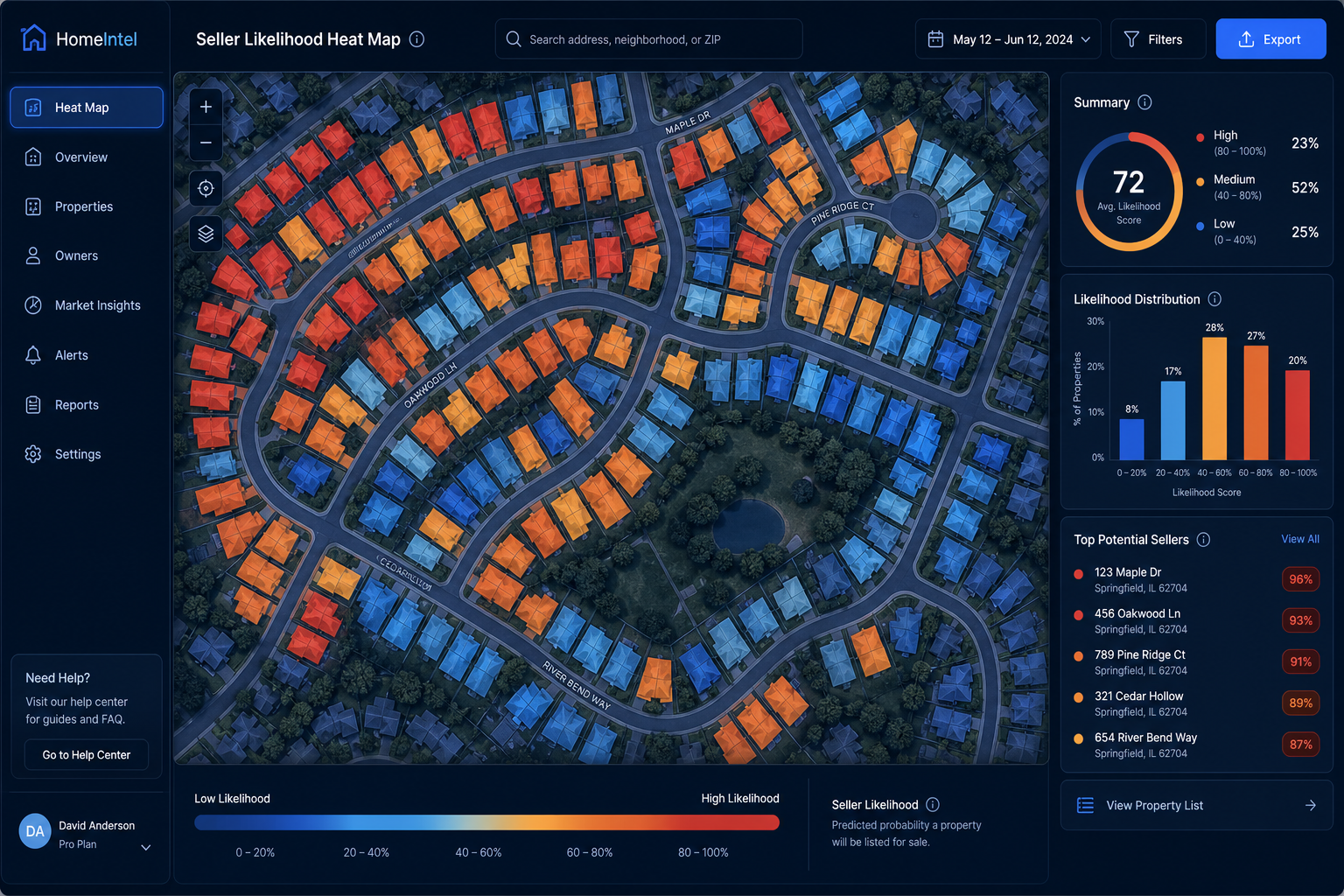
Seller scoring and CMA software work best when they share the same property data.
CMA Software for Real Estate Agents: Pricing and What It Replaces
Standalone CMA tools can cost anywhere from free, limited versions to monthly subscriptions in the $50 to $100 range, and that is often before adding separate tools for leads, dialers, email nurture, and presentation design. In contrast, a bundled platform can replace that entire patchwork for a single, predictable monthly cost.
| Plan | Price | Contact Finds / Month |
|---|---|---|
| Pro | $99/month (3-day trial for $1) | 50 |
| Pro+ | $149/month | 100 |
Both plans include the AI-powered CMA and listing presentation builder, the Marketing Hub, daily priorities, AI coaching, and the Training Academy, in addition to seller scoring and nurture. There are no referral fees, no commission splits, and no long contracts, which works out to roughly $3.30 a day. Full details are available on the pricing page, and billing itself is handled securely through Stripe.
Agents who also lean on social proof and content to generate interest may want to pair their CMA strategy with a stronger outbound push; this guide to a real estate marketing idea that wins more listings covers a few angles worth testing alongside the CMA itself.
Common Mistakes Agents Make When Choosing CMA Software
Even good CMA software gets misused. For instance, some agents treat the generated report as the entire listing pitch instead of a conversation starter, which can make the presentation feel impersonal. Similarly, others choose a tool based purely on design and overlook whether it connects to any seller data at all, leaving them with a nice-looking report and no one new to send it to.
Above all, agents should remember that scores, estimates, and reports are informational tools, not an appraisal or a guarantee of a sale. The best use of CMA software for real estate agents is to speed up the data work so more time goes into the parts of the job a machine cannot do, such as reading a seller's hesitation and addressing it directly.
Agents curious about how data science is reshaping prospecting more broadly can also review this predictive analytics guide to seller leads, which explains how the same scoring models behind modern CMA tools identify likely sellers in the first place.

A clear, well-timed report can turn a curious homeowner into a signed listing.
Frequently Asked Questions About CMA Software for Real Estate Agents
What is CMA software for real estate agents?
CMA software for real estate agents is a digital tool that automatically pulls comparable sales, active listings, and local market data to build a home value report. It replaces manual MLS research and spreadsheet formatting with a branded, client-ready presentation.
How is CMA software different from a manual comparative market analysis?
A manual CMA requires an agent to pull comps by hand, calculate adjustments, and design a presentation from scratch, which can take an hour or more. CMA software automates the data pull and formatting, often producing a polished report in minutes.
How much does CMA software cost for agents?
Pricing varies, but many full-featured platforms that bundle CMA tools with seller leads and marketing run between $99 and $149 a month. SellScore Pro, for example, includes AI-powered CMAs starting at about $3.30 a day.
Can CMA software actually help agents win more listings?
Yes, because a faster, more accurate CMA lets agents respond to seller inquiries before a competing agent does. Speed and professionalism both influence whether a homeowner signs with the first agent they talk to.
What features should agents look for in CMA software?
Look for accurate comp pulls, customizable branding, mobile access, and the ability to present on a tablet during a listing appointment. Integration with seller lead data is also valuable, since it connects the CMA directly to the prospecting pipeline.
Is CMA software included in every SellScore Pro plan?
Yes, AI-powered CMAs and listing presentation tools are part of both the Pro and Pro+ subscriptions. Pro+ also doubles the monthly Contact Find allowance from 50 to 100.
How long does it take to generate a CMA with software?
Most AI-powered platforms generate a first draft of a CMA in a few minutes once an address is entered. Agents typically still review and adjust comps before presenting the report to a homeowner.
What is the biggest mistake agents make with CMA tools?
The most common mistake is treating the CMA as the entire listing presentation instead of one part of the conversation. A strong CMA still needs a human explanation of pricing strategy and market timing to land the listing.
Does CMA software work for FSBO and expired listings?
Yes, CMA software can generate a report for any address, which makes it useful when approaching for-sale-by-owner homeowners or expired listings. Pairing it with seller-signal data helps agents prioritize which of those homeowners to contact first.
How accurate is AI-generated CMA data compared to a formal appraisal?
AI-generated CMAs are informational pricing tools, not appraisals, and should not be treated as a guaranteed value. They are most accurate when the agent verifies comps and factors in condition and upgrades an algorithm cannot see.
Can CMA software integrate with seller lead generation?
Platforms built specifically for listing agents, rather than generic CMA tools, often connect the report directly to seller scoring and contact data. This means the same system that flags a likely seller can also generate the CMA used to approach them.
What is the difference between CMA software and an automated valuation model?
An automated valuation model, or AVM, produces a computer-generated estimate with no agent input. CMA software usually lets the agent adjust comps, add local knowledge, and present the data in a branded report for a specific homeowner.
Is CMA software worth it for new agents?
Yes, because new agents often lack the experience to pull and adjust comps quickly by hand. CMA software shortens that learning curve and helps a newer agent present with more confidence in front of a seller.
Final Thoughts on Choosing CMA Software
In the end, the right CMA software for real estate agents is the one that fits into a complete listing workflow instead of standing alone. A fast, accurate report matters, but it matters more when it is built from the same seller data that told the agent who to approach in the first place. Therefore, agents evaluating their options should weigh not just how good the report looks, but whether the tool helps them find, nurture, and convert sellers from start to finish.
Platforms like SellScore Pro were built by real estate brokers specifically to close that gap, combining seller scoring, contact data, automated nurture, and CMA software for real estate agents in one subscription rather than a patchwork of disconnected tools.

