Predictive analytics real estate seller leads use historical property data, market trends, and homeowner behavior to flag which houses are most likely to list within the next six to twelve months. Instead of guessing which door to knock on, an agent opens a dashboard, sees a score, and works the opportunities the data already points to. This matters because most agents do not actually have a lead shortage; they have a focus problem. They farm neighborhoods blindly, dial stale lists, and chase expired listings alongside every other agent in town, while the homeowners quietly preparing to sell go unnoticed until a competitor's sign appears in the yard.
Direct answer: Predictive analytics for real estate seller leads is the practice of scoring homes based on ownership data, equity, market activity, and life-event signals so agents can prioritize homeowners statistically more likely to sell soon, rather than contacting every property equally.
What Is Predictive Seller Lead Scoring?
Predictive seller lead scoring assigns a value, typically Hot, Warm, or Cold, to a property based on how strongly its data matches patterns seen in homes that sold recently. For example, a homeowner who has owned a property for nine years, built significant equity, and lives near several recent sales often scores higher than a newer owner in a slow-moving block.
Consequently, agents stop treating every contact the same way. Instead, they spend their limited calling hours on the homeowners the model says are worth the effort first, and save broader farming for warm and cold tiers. According to Wikipedia's overview of predictive analytics, this type of modeling has long been used in finance and insurance, and real estate has simply adopted the same statistical logic for prospecting.

A heat map view turns predictive analytics real estate seller leads into a visual daily prospecting priority.
Why Traditional Seller Prospecting Falls Short
Traditional seller lead generation leans on three tactics: cold farming a neighborhood, chasing expired and FSBO listings, or buying leads from a referral network. Each has a built-in weakness. Farming blindly means spending equal time on homeowners who will never sell and the rare few who will. Chasing expireds and FSBOs means arriving after the homeowner already tried once and competing against every other agent with the same list.
Buying leads often makes things worse. Referral platforms frequently take 25 to 40 percent of the resulting commission, lock agents into contracts, and sometimes hand the same lead to several agents simultaneously. As a result, agents end up renting their pipeline instead of owning it. Readers comparing options in depth can see a fuller breakdown in this guide to finding sellers first.
Predictive Analytics Real Estate Seller Leads: How It Works
In practice, predictive analytics real estate seller leads move through a repeatable sequence rather than a single black-box score. The homeowner first gets flagged by a model, then gets contact information attached, then enters an automated nurture track while the agent watches engagement before reaching out personally.
The Six-Step Process
- Find the sellers. The platform scores every property nationwide as Hot, Warm, or Cold using property and market signals, so agents know exactly where to prioritize their prospecting time each day.
- Get the contact. Contact Find adds verified names, phone numbers, and email addresses so agents can reach the homeowner directly instead of guessing who actually lives at a scored address.
- Attract sellers. A Personal Home Value Page lets homeowners share upgrades, like a remodel, pool, or solar install, that automated valuation models usually miss entirely.
- Nurture automatically. One identified lead triggers 48 weekly seller emails sent over nearly a year, keeping the agent visible even during the busiest weeks.
- Track engagement. Dashboards show email opens, link clicks, and report activity, so agents see which homeowners are paying attention and deserve a follow-up call.
- Start the conversation. A professional Wealth Report gives agents a homeowner-facing document that opens real dialogue about value and the possibility of selling.
For a deeper walkthrough of identifying the right homeowners before competitors do, see this step-by-step guide to finding homeowners likely to sell soon.
Seller Signals That Predictive Models Track
Most predictive models weigh a similar set of inputs, even though the exact formula varies by provider. Ownership tenure matters because, according to the National Association of Realtors, the median homeowner now stays in a home for roughly ten years before selling, noticeably longer than a decade ago, which makes tenure a useful timing signal.
Equity position is another strong indicator, since homeowners with substantial built-up equity have more flexibility to move. In addition, nearby sales activity, recent permits, tax record changes, and life events such as a divorce filing or inherited property often push a score higher. Public records sourced from county and U.S. Census Bureau housing data frequently feed these models, which is one reason state and county-level coverage matters when evaluating a platform.
Predictive Seller Lead Scoring vs. Buying Expired and FSBO Lists
The clearest contrast is timing. Expired and FSBO lists only appear after a homeowner has already tried once, which means every agent working that list is calling the same handful of names on the same day. Predictive seller lead scoring instead surfaces homeowners before they decide to sell, often weeks or months ahead of a sign going up.
Furthermore, expired and FSBO leads tend to be emotionally fatigued by failed showings or rejected offers, which can make the first conversation harder. By contrast, a homeowner reached early through a Personal Home Value Page or a Wealth Report is usually just getting curious, not already burned out from a bad experience. Agents interested in comparing full platform options can review this seller lead intelligence platform overview for 2026.

Engagement tracking shows agents exactly which predictive analytics real estate seller leads deserve a phone call next.
Choosing a Predictive Analytics Platform for Seller Leads
Not every scoring tool solves the whole workflow. Some only provide a score, leaving agents to find contact information separately, build their own nurture emails, and track engagement by hand. Others bundle scoring, contact data, nurture, and reporting together, which removes the patchwork of a CRM, a dialer, and separate email software.
SellScore Pro, built by real estate brokers, takes the bundled approach. Pro includes 50 Contact Finds monthly for about $99 a month after a $1, 3-day trial, while Pro+ doubles that to 100 for $149 a month, with no referral fees, commission splits, or long-term contract. Agents can compare that structure against other prospecting software in this review of prospecting software that finds sellers first, or start directly at sellscorepro.com.
Frequently Asked Questions About Predictive Analytics Real Estate Seller Leads
How do predictive analytics real estate seller leads work?
Predictive analytics real estate seller leads work by combining property records, ownership data, and market trends into a model that scores how likely a home is to list soon. Agents use that score, usually shown as Hot, Warm, or Cold, to decide who to contact first.
What data goes into a seller lead prediction score?
Most models combine ownership tenure, equity position, nearby sales activity, tax and permit records, and life-event indicators such as divorce filings or estate transfers. SellScore Pro layers state, county, and ZIP-level market data on top of these signals to refine each score.
Is predictive seller lead scoring more accurate than buying expired or FSBO lists?
Expired and FSBO lists only surface homeowners after they already tried and failed to sell, so every agent in town calls the same names. Predictive scoring instead flags homeowners before they list, giving agents a genuine head start instead of a shared leftover list.
How much does SellScore Pro cost?
SellScore Pro offers a 3-day trial for $1, then renews at $98 for the first month and $99 a month after that for Pro; Pro+ is $149 a month. That works out to roughly $3.30 a day with no referral fees, commission splits, or long-term contract.
Does predictive analytics guarantee a homeowner will sell?
No. Scores, estimates, and reports from any seller-intelligence platform are informational tools meant to guide prospecting, not an appraisal, legal advice, or a guarantee that a transaction will happen.
How long does nurturing a predicted seller lead usually take?
Many platforms, including SellScore Pro, automate contact for nearly a year, sending one email a week for 48 weeks. This matters because seller timelines rarely match an agent's outreach calendar.
What is the biggest mistake agents make with seller lead data?
The most common mistake is treating every lead as equally urgent and burning hours on CMAs for homeowners who were never close to listing. Prioritizing by seller-likelihood score first avoids wasted effort on cold contacts.
Can predictive analytics find seller leads in every U.S. state?
Coverage varies by provider, but platforms built on national property data, such as SellScore Pro, score eligible residential properties across all 50 states using state, county, and ZIP-level market data.
How is a Hot, Warm, or Cold score calculated?
Hot signals the strongest combination of seller indicators right now, Warm flags homes worth nurturing and watching, and Cold represents long-term pipeline building. The exact weighting depends on the platform's model, but most blend ownership tenure, equity, and market movement.
Do I still need a separate CRM if I use predictive seller lead scoring?
Many standalone scoring tools still require a separate CRM, dialer, and nurture platform, which is why integrated systems that combine scoring, contact data, and automated nurture save agents from juggling multiple subscriptions.
How quickly can an agent see results from predictive seller leads?
Results depend on local market conditions and how consistently an agent works the highest-scored contacts. However, most agents report their first warm conversations within 30 to 60 days of steady outreach.
What is a Personal Home Value Page and how does it relate to seller leads?
It is a landing page homeowners visit to see an estimated value and share details automated valuations miss, like a remodel or pool. This turns anonymous curiosity into real seller intelligence an agent can act on.
Is predictive analytics only useful for listing agents, or does it help buyer's agents too?
It is built primarily for listing-side prospecting since the scores identify homeowners likely to sell. That said, buyer's agents can use the same homeowner relationships to source future listing referrals.
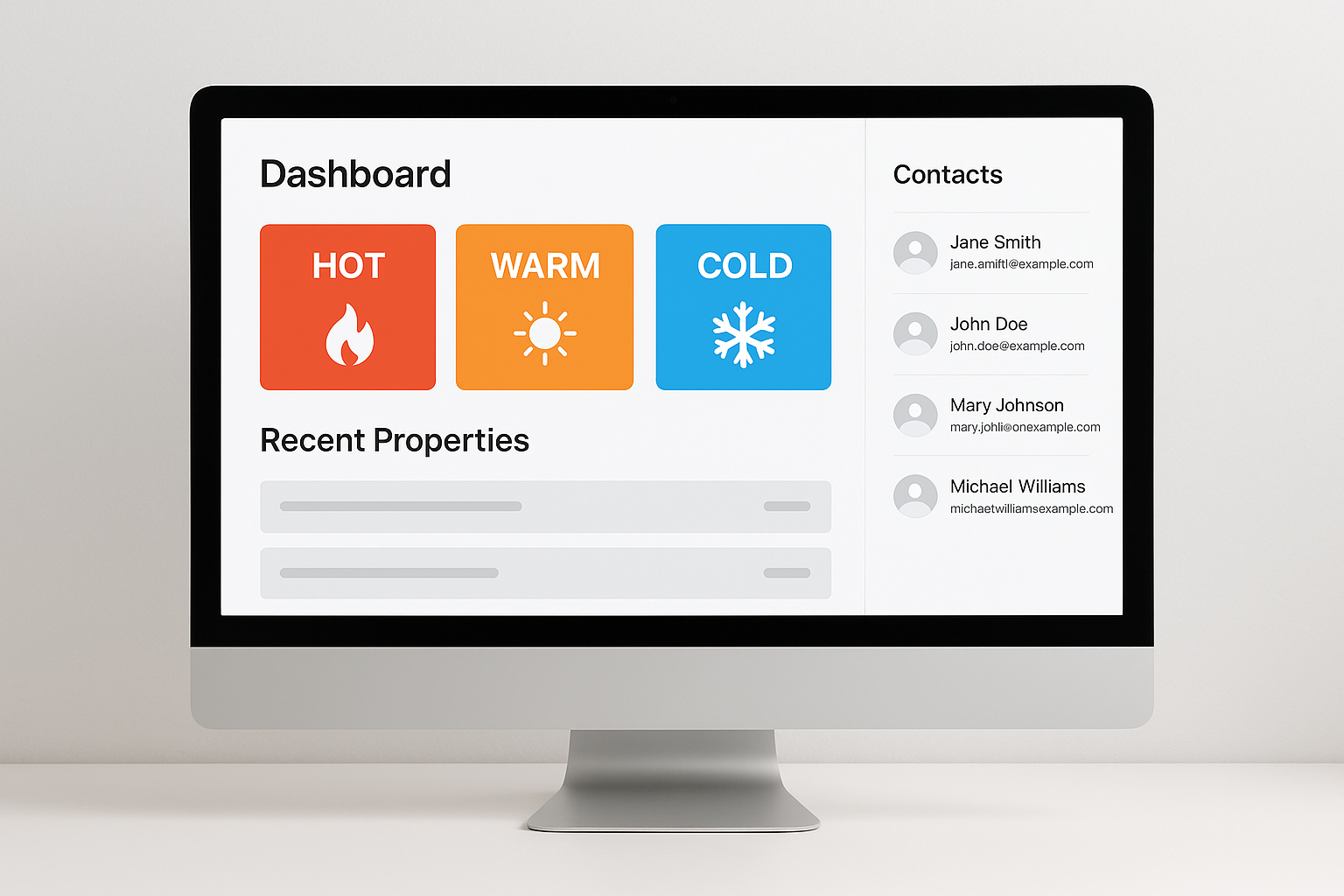
A scored contact list turns daily prospecting into a focused, prioritized task list.
Final Thoughts
Predictive analytics real estate seller leads give agents something stale lists and rented referrals never could: a reason to believe a homeowner is actually ready before a competitor finds out. Instead of farming blindly or buying leads that get split among several agents, a well-built scoring system turns data into a daily, prioritized list of real opportunities. Agents who pair that scoring with automated nurture, engagement tracking, and a clear outreach process tend to spend less time guessing and more time having the right conversation with the right homeowner at the right moment.
