Real estate AI tools for listing agents are reshaping how agents find sellers, build presentations, and stay in front of homeowners long before a yard sign goes up. Instead of cold-calling expired listings alongside dozens of other agents, more listing agents now rely on software that scores properties, tracks engagement, and automates follow-up. This guide breaks down what these tools actually do, how to evaluate one, and where a platform like SellScore Pro fits into a modern listing business.
Direct answer: Real estate AI tools for listing agents use property and market data to flag homeowners showing seller signals, then help agents turn those opportunities into signed listings through automated contact, nurture, and presentation features. They are informational tools, not a guarantee of any specific listing or closing.
What Are Real Estate AI Tools for Listing Agents?
Real estate AI tools for listing agents are software platforms that use artificial intelligence, a technology that lets computers find patterns in large data sets, to analyze property and market activity and highlight homeowners who show signs of being ready to sell. Instead of a generic farm list, agents receive a prioritized view of where seller signals are strongest.
In practice, that usually means a few layers working together. First, a scoring engine sorts homes into tiers. Then, contact tools fill in owner names, phone numbers, and emails. Finally, nurture and presentation tools help the agent act on that information without starting from a blank page every time.
Scores, estimates, reports, and product guidance from this category of software are informational tools. They are not an appraisal, legal advice, a guarantee of a transaction, or a promise of an outcome. Agents remain responsible for independent professional judgment, factual property review, and compliance with applicable outreach rules and brokerage policy.

An agent using real estate AI tools for listing agents to review property signals before prospecting.
Why Listing Agents Need Seller Intelligence, Not Just More Leads
Most agents do not actually have a shortage of leads. Instead, they have a focus problem. They farm neighborhoods broadly, call through stale lists, and chase expired listings and FSBOs alongside every other agent in town. Meanwhile, homeowners who are quietly preparing to sell often go unnoticed until a sign appears in the yard with someone else's name on it.
Buying leads from referral platforms can make this worse. Many of those services take a meaningful percentage of commission, lock agents into contracts, and distribute the same lead to multiple agents at once. As a result, agents end up renting their pipeline instead of owning it.
According to research published by the National Association of Realtors, the large majority of home sellers historically work with a listing agent rather than selling independently. That means the opportunity is rarely about finding sellers who exist somewhere; it is about identifying which specific homeowners are closest to being ready and reaching them first.
Core Categories of AI Powered Listing Software
Not every platform in this space does the same thing. Understanding the main categories makes it easier to compare options and avoid paying for features that overlap with tools an agent already owns.
Seller Signal Scoring and Heat Maps
This is the foundation layer. Properties are scored, often labeled Hot, Warm, or Cold, based on signals like ownership length, equity trends, and nearby market activity. A Heat Map view then shows agents at a glance where the strongest opportunities are clustered around any given address, which helps spot openings other agents overlook.
Contact Find and Outreach Compliance
Finding a property is only step one. Contact Find features add names, phone numbers, and emails so an agent can actually reach the homeowner. However, having a phone number is not automatic permission to call or text. Agents must still follow applicable Do Not Call and TCPA rules, as well as their brokerage's outreach policy, every time they make contact.
Automated Seller Nurture
A single contact rarely converts on the first call. That is why many platforms include nurture sequences, sometimes a weekly email sent automatically for close to a year, so homeowners keep hearing from the agent even when the calendar is full.
AI Powered CMA and Listing Presentations
Building a Comparative Market Analysis (CMA), a report comparing a home to similar recently sold properties, by hand can take an hour or more. AI assisted CMA and listing presentation builders speed up that research and formatting, though agents still need to review the comparables and apply local market judgment before presenting pricing to a homeowner.
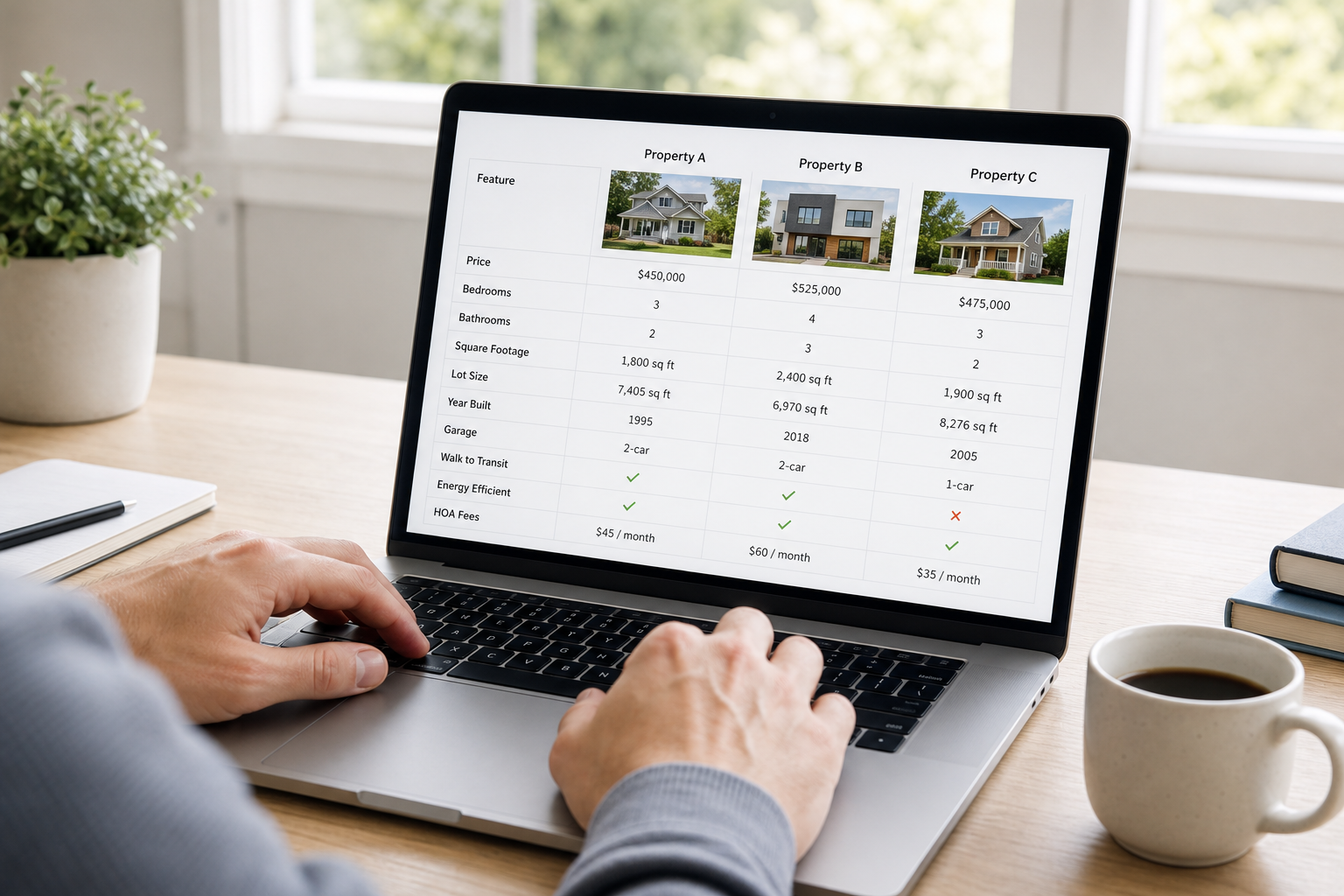
Speeding up CMA research is one of the most common uses for real estate AI tools for listing agents.
Seller Signal Tiers at a Glance
The table below summarizes how most scoring tiers are typically used in day-to-day prospecting decisions.
| Signal Tier | What It Typically Means | Suggested Agent Action |
|---|---|---|
| Hot | Strongest current seller signals | Prioritize outreach and follow brokerage contact rules |
| Warm | Worth nurturing and watching | Add to automated nurture sequences |
| Cold | Long-term pipeline building | Keep in gradual nurture for future seasons |
How SellScore Pro Approaches Seller-Lead Intelligence
SellScore Pro was built by real estate brokers as a listing agent operating system rather than a single-purpose lead list. It scores eligible residential properties across all 50 states into Hot, Warm, and Cold tiers, then layers a Heat Map on top so agents can see where opportunities cluster around any address.
From there, Contact Find adds verified names, phone numbers, and emails, with Pro including 50 contacts each month and Pro+ including 100. Every agent also gets a Personal Home Value page homeowners can use to share upgrades, like a remodeled kitchen or a new roof, that automated estimates typically miss, turning anonymous curiosity into a real conversation starter.
Once a homeowner is identified, a 48-week automated nurture sequence keeps the agent in front of them roughly once a week, while engagement tracking shows email opens, link clicks, and Wealth Report activity so agents know who is actually paying attention. The platform also includes an AI powered CMA and listing presentation builder, a Marketing Hub, 7AM Accountability daily priorities, a Pipeline view, an AI Coach with scripts and playbooks, and a full Training Academy.
There are no referral fees, commission splits, or long contracts. Pricing starts with a one-time 3 day trial for $1, then $98 at first renewal, followed by $99 a month for Pro or $149 a month for Pro+, and agents can cancel anytime. For a closer look at related workflow pieces, see this breakdown of listing presentation software built for agents and this guide to listing prospecting strategies.
How to Choose the Right AI Listing Tools
With several categories available, comparing platforms side by side helps avoid paying twice for overlapping features. The steps below outline a practical evaluation process.
- Define your seller criteria by deciding which neighborhoods, price ranges, and signal levels matter most before evaluating software, so the tool's scoring model actually matches the opportunities you want to work.
- Check contact and compliance features to confirm the platform provides owner contact details and clearly reminds agents to follow Do Not Call and TCPA rules alongside brokerage policy before any outreach begins.
- Review the automation and nurture tools by looking for built-in follow-up sequences, such as weekly homeowner emails, so a prospect found once continues to hear from the agent automatically for months.
- Test the presentation and CMA tools by requesting a demo to see whether it saves meaningful time compared with spreadsheets or manual templates currently in use.
- Evaluate coaching and support resources by asking whether the platform includes scripts, playbooks, or a training academy, since adopting new technology works best when agents also receive guidance on daily use.
Common Mistakes Agents Make With AI Listing Software
Even strong software can underperform when the process around it breaks down. One frequent mistake is treating contact information as automatic permission to call or text, which ignores Do Not Call and TCPA requirements as well as brokerage policy. Another is ignoring engagement data entirely, which means agents miss homeowners who are quietly showing real interest through email opens or report activity.
A third mistake is abandoning nurture sequences too early. Since a homeowner's decision to sell often develops over months, stopping follow-up after one unanswered call can waste the exact signal the software identified in the first place. Similarly, some agents try to replace manual CMA judgment entirely with automation, which can lead to pricing recommendations that do not reflect local nuance.
For agents looking to pair this technology with broader outreach ideas, this list of marketing ideas for listing agents and this overview of using ChatGPT for real estate agent tasks offer practical next steps.

Ongoing coaching helps agents get more consistent value from real estate AI tools for listing agents.
Comparing Options Before You Commit
Because pricing structures, contact quantities, and feature sets vary widely across this category, it is worth reviewing more than one option before subscribing. A side-by-side comparison of seller lead software options can help agents see how coverage, nurture length, and presentation tools stack up against each other.
Whatever platform an agent chooses, the underlying goal stays the same: spend less time guessing where to prospect and more time having real conversations with homeowners who are genuinely close to a decision. Full feature and pricing details for one such platform are available directly at sellscorepro.com.
Frequently Asked Questions
What are real estate AI tools for listing agents?
Real estate AI tools for listing agents are software platforms that analyze property and market data to flag homeowners who show signs of getting ready to sell. They typically combine seller scoring, owner contact information, automated nurture, and presentation tools in one place.
How do these tools help agents find seller signals?
They score properties using data points such as ownership length, equity trends, and local market activity, then group homes into tiers like Hot, Warm, and Cold. Agents can then prioritize outreach toward the homes showing the strongest signals instead of calling at random.
Are AI seller scores the same as a home appraisal?
No. Scores, estimates, and reports generated by this type of software are informational tools, not an appraisal, legal advice, or a guarantee of a transaction. Agents are still responsible for independent professional judgment and factual review of the property.
How much do real estate AI tools for listing agents typically cost?
Pricing varies by provider, so it helps to compare monthly cost against what is actually included, such as contact quantities and nurture automation. SellScore Pro, for example, offers a 3 day trial for $1, then $98 at first renewal, followed by $99 a month for Pro or $149 a month for Pro+, available one time only and cancelable anytime.
Can AI tools replace a listing agent's CMA process?
AI powered CMA and listing presentation builders can speed up research and formatting, but they do not replace the agent's market knowledge or judgment. Agents still need to review comparable sales and local conditions before presenting pricing to a homeowner.
Is it legal to call or text homeowners found through AI contact tools?
Contact details provided by this type of software are not automatic permission to call or text. Agents must still follow applicable Do Not Call and TCPA rules, which are outlined by agencies like the Federal Communications Commission, along with their brokerage's outreach policy.
How long does it take to see results from AI prospecting tools?
Results depend on market conditions, follow-up consistency, and how actively an agent works the opportunities surfaced by the software. Because these platforms are informational tools, no specific number of listings, closings, or leads can be promised.
What is the difference between Hot, Warm, and Cold seller signals?
Hot signals indicate homeowners showing the strongest current indicators of being ready to sell, Warm signals suggest a homeowner worth nurturing and watching, and Cold signals represent longer-term pipeline building. Agents typically prioritize Hot and Warm tiers first while nurturing Cold contacts over time.
Do real estate AI tools work in every U.S. state?
Coverage varies by provider, so agents should confirm whether a platform scores eligible residential properties nationwide or only in select markets. Checking state, county, and ZIP level coverage before subscribing helps avoid surprises after signup.
What mistakes do agents make when adopting AI listing tools?
Common mistakes include ignoring compliance rules around calling and texting, overlooking engagement data that shows which homeowners are actually paying attention, and abandoning nurture sequences too early. Treating the software as a full replacement for follow-up, rather than a tool that supports it, tends to produce weaker results.
How does SellScore Pro fit into the real estate AI tools category?
SellScore Pro combines nationwide seller scoring, a Heat Map, Contact Find, automated nurture, a Personal Home Value page, AI powered CMAs, a Marketing Hub, and an AI Coach into one platform built by real estate brokers for listing agents. It is designed to replace a patchwork of separate lead lists, dialers, and presentation tools.
Should new agents use AI tools or focus on manual prospecting first?
New agents generally benefit from learning core prospecting and presentation skills while also using software to prioritize where that effort goes. AI tools work best as a focus aid rather than a substitute for phone skills, follow-up discipline, and local market knowledge.
Final Thoughts
Real estate AI tools for listing agents are not a shortcut around the work of selling homes. Instead, they help agents decide where to spend their limited prospecting time, how to stay in front of homeowners consistently, and how to show up prepared when a conversation finally starts. The strongest results tend to come from agents who treat the scoring, contact, and nurture features as support for disciplined, compliant follow-up rather than a replacement for it.
Whether an agent is comparing platforms for the first time or replacing a patchwork of separate tools, understanding how real estate AI tools for listing agents actually work makes it far easier to choose one that fits a specific market and workflow. Scores, estimates, reports, and guidance from any platform in this category remain informational, and agents should always apply independent judgment and follow applicable outreach rules and brokerage policy before contacting a homeowner.

